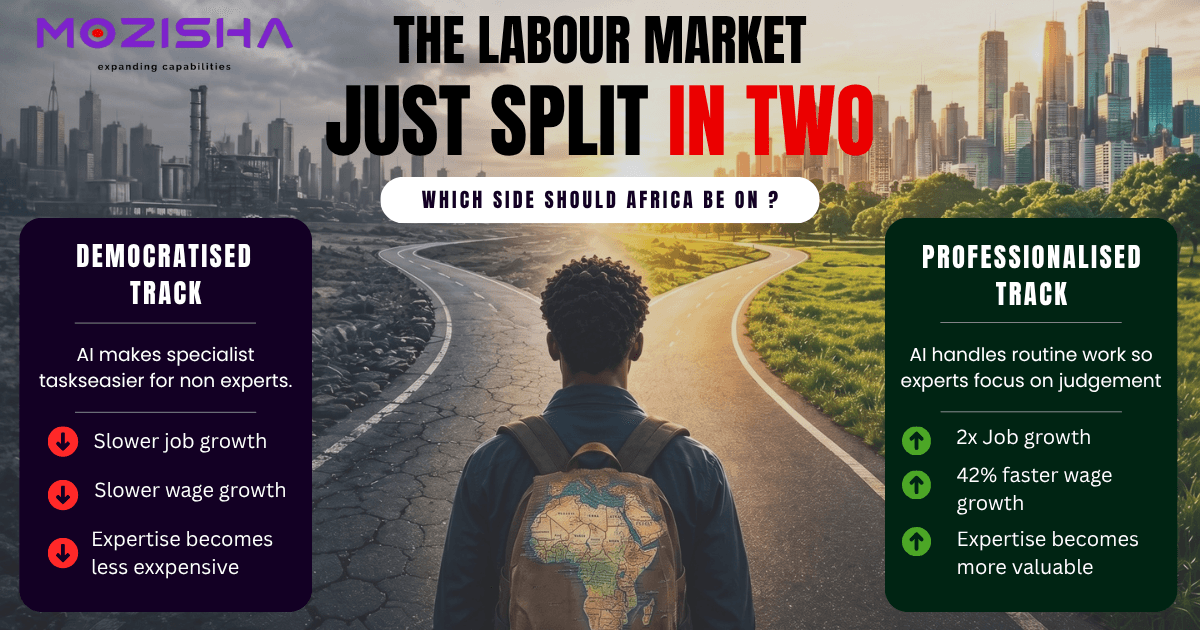
The global labour market is splitting into two distinct tracks. And which track a young African professional lands on will shape the arc of their entire career.
PwC released its 2026 Global AI Jobs Barometer in June, drawing on analysis of over one billion job ads across 27 countries and territories on six continents. The report's central finding is this. AI is not creating one labour market story. It is creating two, running in opposite directions at the same time.
PwC calls the first track professionalised. These are roles where AI automates the routine cognitive work, freeing human experts to focus on judgment, decision-making, and the kind of work that requires genuine expertise. Think of a radiologist whose AI tool scans thousands of images and flags anomalies. The radiologist still has to interpret the flags, hold the conversation with the patient, make the call under uncertainty. AI has raised the floor of what the role produces. It has not replaced the human at the centre of it.
PwC calls the second track democratised. These are roles where AI makes the task itself easier, lowering the barrier for non-experts to perform work that previously required specialist training. An IT service manager whose primary function was configuring systems that AI now configures automatically. A medical secretary whose scheduling, documentation, and communication tasks have been significantly absorbed by tools. The work is not gone entirely. But AI has made it less specialised, less scarce, and therefore less valuable.
The numbers that sit behind this distinction are significant. Professionalised roles are seeing twice the growth in available jobs and 42% faster salary growth than democratised roles. Jobs requiring specific AI skills are growing roughly eight times faster than the overall jobs market. Globally, roles requiring AI skills now carry an average advertised wage premium of 62% over equivalent roles that do not require those skills.
Two tracks. Identical starting points in terms of credentials. Completely different trajectories in terms of growth, pay, and relevance over the next decade.
What determines which track you land on
The distinction between the two tracks is not industry. It is not seniority. It is not even whether your job involves AI or not. Every knowledge worker's job now involves AI to some degree.
The distinction is whether AI is making your expertise more valuable or less necessary.
In professionalised roles, AI is a force multiplier. It does more of the specified work, which frees the human to do more of the judgment work. The human's expertise becomes the scarce resource, and scarce resources command premiums.
In democratised roles, AI is a barrier lowerer. It makes the task accessible to people who previously lacked the training to perform it. When a task becomes accessible to everyone, the people who used to be paid to do it exclusively find that their market position has weakened.
The difference, put plainly, is this. Are you the person the AI is working for, or are you the person the AI is working around. The first group is on the professionalised track. The second group is on the democratised track. And the data shows they are heading in opposite directions.
Where most African graduates currently sit
The majority of African graduates entering the labour market right now are being prepared, by their universities and by their own career strategies, for the democratised track. Not by choice. By default.
Consider what most African university curricula are still built around. Information retrieval. Task execution. The ability to produce a correct answer from a well-defined problem. These are exactly the capabilities that AI is making more accessible to non-experts. When a graduate's primary value proposition is the ability to draft a report, run a standard analysis, or process a well-defined request, they are competing on a track where AI is lowering the barrier every quarter.
The professionalised track requires something different. It requires the ability to do the work that sits above the task. Reading a situation when the data is incomplete. Making a judgment call when the model gives a confident wrong answer. Building a relationship with a client in Nairobi whose trust cannot be earned through a chatbot. Knowing when a business owner in Lagos is telling you what they want when what they actually need is something different. These are not skills you learn by studying harder. They are capabilities built through deliberate practice, real exposure, and the kind of training that most formal education is not designed to provide.
The honest diagnosis is this. Africa's universities are largely producing graduates for a track that is shrinking. The skills they are developing are being automated away. And the track that is growing, the one with twice the job growth and 42% faster wage increases, requires a different kind of preparation that the system is not yet providing at scale.
What the professionalised track actually demands
To understand what moving to the professionalised track requires, it helps to look at what the roles on that track have in common.
A recruiter whose AI tool screens hundreds of applications in minutes still has to decide who to call, how to read the conversation, and whether the person on the other end of the call will actually thrive in the role being filled. The AI handles the volume. The recruiter handles the judgment.
A radiologist whose AI tool flags potential tumours still has to interpret what the flag means in the context of this specific patient, this specific history, this specific set of clinical factors. The AI handles the pattern recognition at scale. The radiologist handles the clinical reasoning.
A growth operator whose AI tools draft content, research competitors, and analyse campaign data still has to decide what the data actually means for this company, in this market, at this moment. The AI handles the information. The operator handles the insight.
In every case, the human on the professionalised track is doing the same thing. They are using AI to clear the routine work off their desk so they can spend more of their time and attention on the work that requires genuine human capacity. Judgment. Contextual intelligence. The ability to read situations that the model was not trained on.
The new tasks being added to AI-exposed roles are 2.5 times more likely to rely on skills like empathy, judgment, and creativity than the tasks they are replacing. These are skills that do not develop automatically. They have to be built, practised, and refined through experience.
The African opportunity
Africa has structural advantages for the professionalised track that are not being emphasised enough.
The continent has the youngest population on earth. It has more young people with the energy, adaptability, and hunger to build new capabilities than any other region. It has a generation that grew up solving problems with limited resources, which is exactly the disposition that judgment-led work rewards. It has cultural contexts, languages, business environments, and social nuances that no model trained elsewhere can fully replicate, which means African operators bring contextual intelligence to global work that is genuinely scarce and genuinely valuable.
The raw material for the professionalised track is here. What is missing is the preparation.
Most African graduates are not arriving at the job market AI-fluent. They are not arriving with the judgment capabilities the professionalised track demands. They are not arriving ready to direct AI rather than be displaced by it. And the reason is not a lack of potential. It is a lack of the right training environment.
What Mozisha is building
This is the gap Mozisha exists to close.
We train African operators specifically for the professionalised track. Technical fluency is the starting point, not the endpoint. Our operators learn to use AI tools to clear the routine work off their desks. Then we build the layer underneath: how to read a client situation when the data is ambiguous, how to hold a difficult conversation that a model cannot have, how to bring cultural and contextual intelligence to a global role in a way that is impossible to automate.
The operators who complete our programmes do not arrive at global companies as generalists hoping to be trained. They arrive as professionals who can direct AI, deliver judgment from day one, and provide the kind of human value that sits firmly on the professionalised track.
This is not a small ambition. We are aiming for one million young Africans on this track by 2031. The labour market has split. The window to get on the right side of that split is open now. It will not stay open indefinitely.
The two tracks are diverging in real time. Job growth on the professionalised track is twice that of the democratised track. Wage growth is 42% faster. The gap is widening every year.
Africa has the people. The question is whether we will build the training infrastructure to put them on the right track before the divide becomes a chasm.