This week, Mozisha founder Dr. Kenechukwu Ikebuaku published a commentary on UCL Institute for Global Prosperity's The New Alignment, the policy hub feeding into the UK's 2027 G20 Presidency. It's a direct response to a provocation from Gabriela Ramos and Emilija Stojmenova Duh, two of the leading voices in the digital sovereignty debate, and it makes an argument that sits at the center of what Mozisha has been building since 2020.
The argument, briefly
Ramos and Stojmenova Duh argue that digital sovereignty is about more than who owns the data centre, it's about whether a citizen's relationship to the state stays legible and accountable once an AI system sits in between. Dr.Kene agrees, and pushes the argument a layer deeper. A government can win every safeguard on that list, full data residency, audit rights, exit clauses, and still end up governed by a system that cannot hold its citizens' language, categories, or reasoning. No clause has been broken. Something has still been lost.
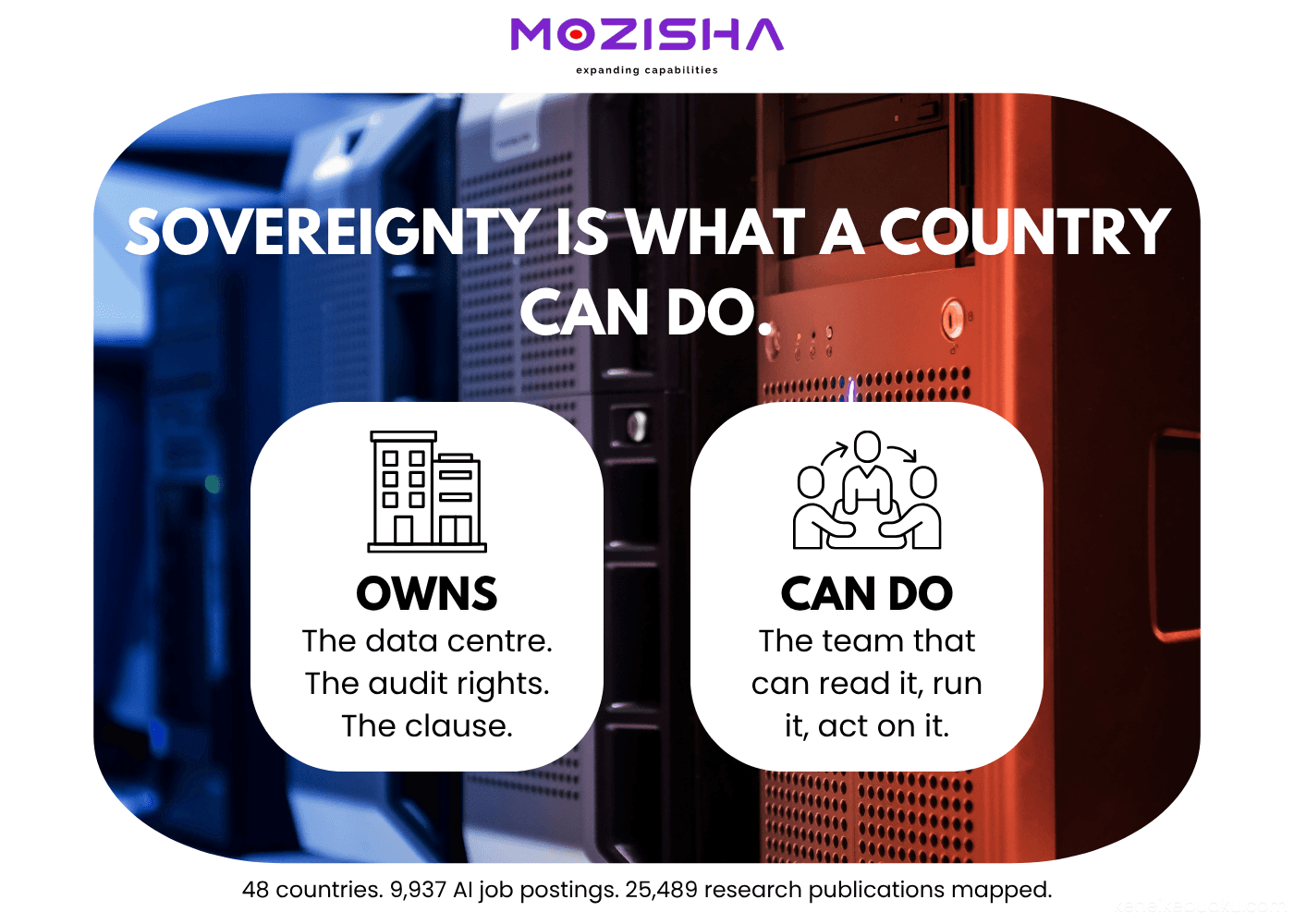
The piece draws on Amartya Sen's capability approach, the same framework underpinning Dr. Kene's own PhD research, to reframe sovereignty as something a country does, not something it possesses. A country that owns a data centre it cannot staff has a building. A country holding audit rights it has no one trained to exercise has a document. In both cases, the resource exists and the capability doesn't.
The finding that gives this teeth
This isn't just a philosophical reframe. Dr. Kene led talent landscape mapping across 48 African countries for the GSMA's African AI Languages Model Project, synthesizing nearly 10,000 AI job postings, over 25,000 research publications, and more than 27,000 open-source repositories into country-level capability data. The sharpest shortages weren't in model building. They clustered exactly where enforcement depends: model evaluation, AI safety, AI governance. A transparency clause is only as real as the domestic team able to act on it. Where that team doesn't exist, the clause is a right nobody can exercise.
That's where the piece cites Mozisha directly. In a pilot AI Employability Lab run with the University of the Western Cape earlier this year, roughly 100 students from law, medicine, commerce, and mathematical statistics trained in AI evaluation, governance, and human oversight. They rated the career value 8.5 out of 10, and every one of them said they'd recommend it onward. Small, early, and exactly the kind of proof the argument needed: this capability can be built quickly and affordably, inside ordinary public universities. The constraint is a policy choice, not a natural one.
Why this matters beyond one essay
The piece closes on ATLAS Umoja AI, the five-government coalition Mozisha is a founding partner of, as a working answer to a problem no single African state can solve alone: pooling language data, talent, and research at a scale that can actually negotiate with a frontier lab. The test now is whether that coordination holds at the ITU Plenipotentiary Conference in Doha later this year.
The full piece is worth reading in full, it's a sharper, more rigorous case for why training people, not just securing infrastructure, is the real sovereignty question, and it's now part of the record at one of the more consequential policy venues heading into 2027.
Read the full commentary on The New Alignment.