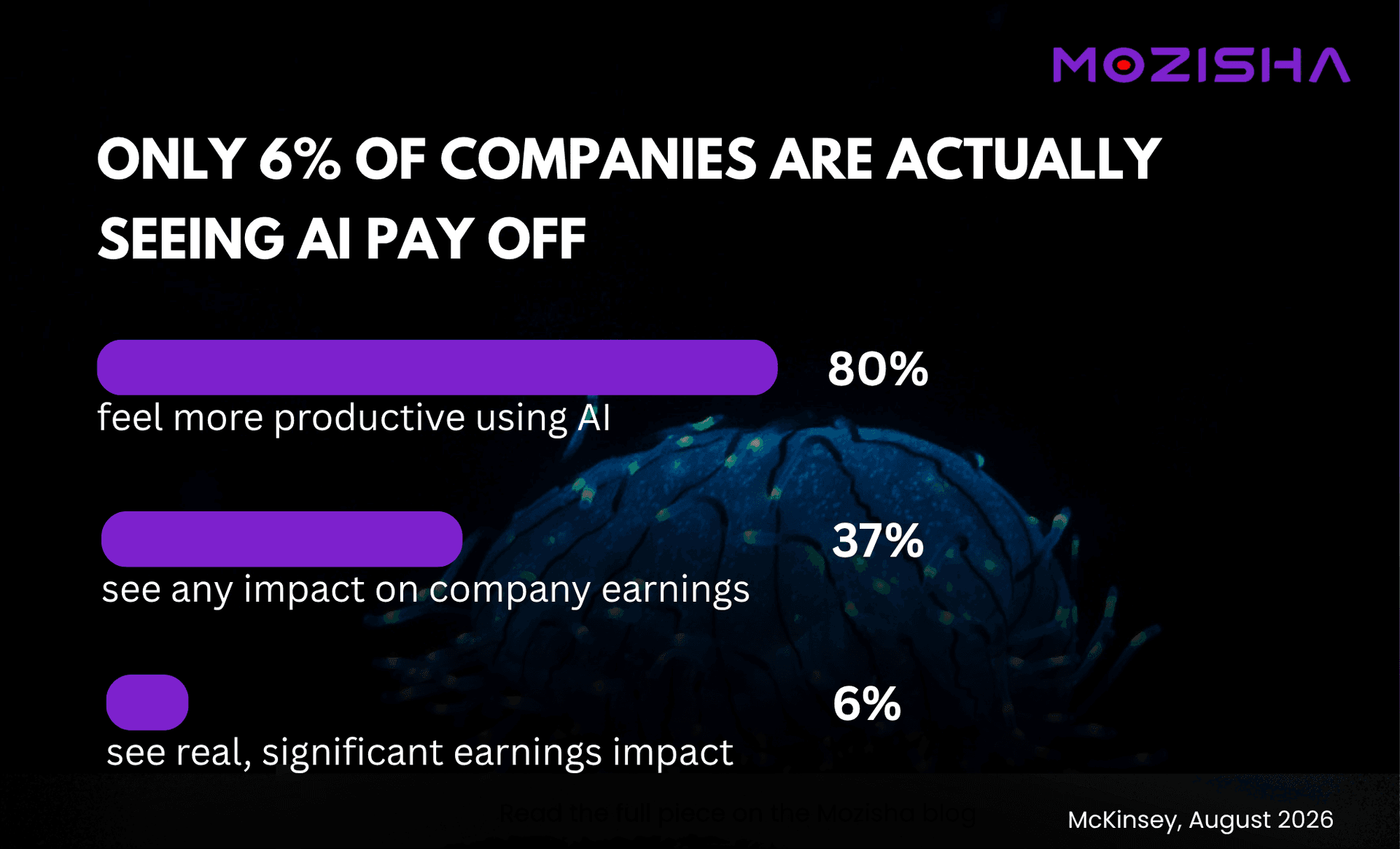
McKinsey's newest global survey, published August 2026 and drawn from 1,719 executives across 97 countries, found that 80% of individual workers report real productivity gains from AI. Only 37% of organizations report any positive impact on enterprise-level earnings, essentially flat from a year earlier. Just 6% qualify as genuine "AI high performers," attributing 5% or more of EBIT to AI with significant impact. That gap, between what individuals feel and what shows up on the balance sheet, isn't a story about whether AI works. It's a story about who's using it right.
Airbnb sits in the 6%
On Airbnb's Q2 2026 earnings call, CEO Brian Chesky reported the company shipped nearly 80% more features and improvements in the first half of 2026 than the same period a year earlier, with headcount roughly flat. That took a CTO-level hire, Ahmad Al-Dahle, formerly head of generative AI at Meta and the Llama models, and a real rebuild of how the company engineers product. It's not a chatbot license. McKinsey's own data on what separates high performers explains why that distinction is exactly the one that matters.
The mistake isn't using AI. It's where you put it.
McKinsey's research is direct on this point: high performers are the organizations that fundamentally redesign workflows around AI, not the ones that bolt AI onto existing processes. A bank offering employees a chatbot for ad hoc questions is applying AI to a task. A bank deploying agents alongside people to approve, process, and manage loans end to end is redesigning a workflow. Both count as "using AI." Only one of them shows up in the 6%.
McKinsey's separate research on skills and automation adds the scale of what's at stake in getting this right: across more than 190 mapped business workflows, roughly 60% of AI's potential economic value sits in sector-specific, core-business processes, not the generic administrative tasks most pilots target first.
The skills data says the same thing, at the level of a single job
Drawn from 11 million job postings, McKinsey also found demand for AI fluency has grown nearly sevenfold in two years, faster than any other skill. But its Skill Change Index found coaching, negotiation, and leadership among the most durable skills through 2030, not the most exposed, and that roughly 72% of all skills studied are used in both automatable and non-automatable work. Most people aren't being replaced or left untouched. They're applying the same skill differently, inside a redesigned process, handling what still needs judgment while AI takes what doesn't.
Most companies can't build what Airbnb built
Airbnb's version took years, a world-leading AI hire, and the resources of a $100 billion company. That's not repeatable for a business trying to close the same gap on a fraction of the budget.
That's the case for training and embedding AI-fluent talent rather than building the capability from scratch. An operator who already knows how to work inside a redesigned, AI-augmented process is a shortcut to Airbnb's outcome without Airbnb's years-long build. Mozisha trains and embeds exactly that kind of operator, so the 6% isn't reserved for companies with Airbnb's resources.
Sources: McKinsey & Company, "The State of AI in 2026: On the Road to ROI" (August 2026); McKinsey Global Institute, "Agents, Robots, and Us: Skill Partnerships in the Age of AI" (November 2025); Airbnb Q2 2026 earnings call, CEO Brian Chesky (August 2026); Airbnb newsroom, CTO appointment announcement (January 2026).