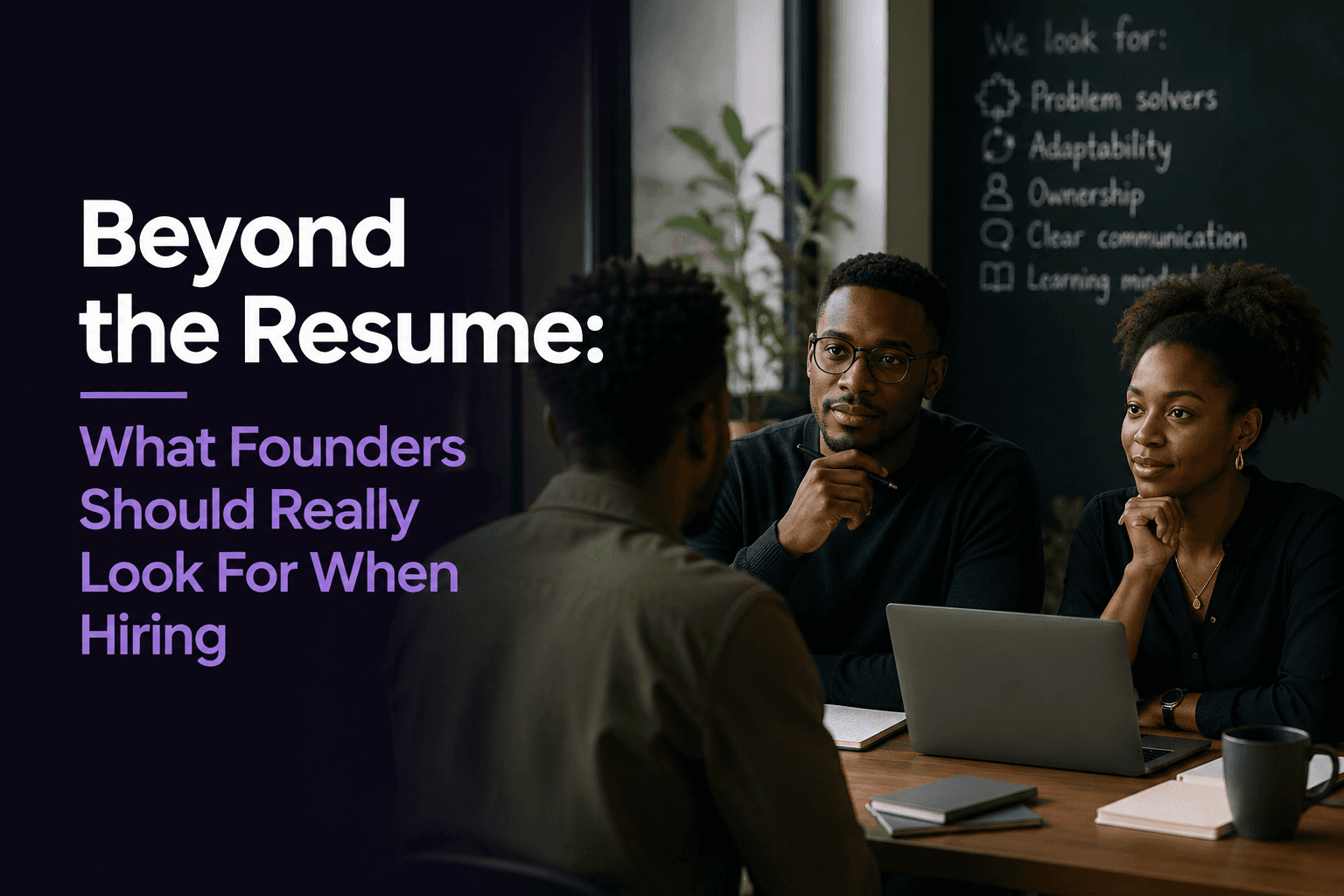
A decade ago, a polished resume often served as the strongest signal of a candidate’s potential. Recruiters reviewed experience, qualifications, and career progression, then made hiring decisions with relatively limited information. Today, access to talent has expanded, but evaluating talent has become more complex.
Hiring teams have access to more candidates than at any other point in recent digital history. Professional networking platforms have expanded global talent pools, remote work has removed geographical barriers, and artificial intelligence now helps candidates refine resumes, optimise LinkedIn profiles, and generate tailored cover letters in minutes. On paper, many applicants have never looked more qualified.
For many startup founders, hiring no longer begins with geography. It begins with access.
A product team in London can collaborate with engineers in Lagos, a designer in Nairobi, and a customer success specialist in Cape Town without opening another office. Advances in remote work, digital collaboration tools, and global recruitment platforms have reshaped how young companies build teams.
Yet expanding access to talent has introduced a different challenge. Founders are no longer limited by where they can hire. They are increasingly challenged by how to identify professionals who can deliver in fast-moving startup environments. As AI-assisted applications, polished online profiles, and larger global talent pools become the norm, distinguishing genuine capability from strong presentation is becoming a more important part of the hiring process.
The past few years have fundamentally changed how startups approach recruitment. Roles that were once filled through local networks can now attract applicants from multiple countries within days. Remote work, digital collaboration tools, and professional networking platforms have made global hiring more accessible than at any point in recent history.
According to LinkedIn’s 2025 Work Change Report, 58% of professionals worldwide planned to look for a new job in 2025, while almost 40% reported applying for more jobs than ever before but hearing back less. On the employer side, 73% of HR professionals said that fewer than half of the applications they receive fully meet the role requirements.These figures point to an important shift. The challenge for founders is no longer limited to attracting applicants, but it is specifically about identifying the individuals who possess the judgment, adaptability, and problem-solving ability needed in fast-moving startup environments.
The future of startup hiring may not
depend on finding more candidates. It may depend on recognising better signals.
The Resume is a Starting Point, Not the Hiring Decision
A resume still serves a purpose. It summarizes experience, highlights achievements, and provides a snapshot of a candidate’s background. However, in today’s hiring landscape, it is no longer sufficient as the primary indicator of future performance.
This shift is becoming increasingly important as startups compete in markets where execution speed often determines success. According to LinkedIn’s Future of Recruiting research, employers are placing greater emphasis on demonstrated skills and practical capabilities than on traditional credentials alone. Skills-based hiring continues to expand because it widens the talent pool while improving the likelihood of finding candidates who can deliver measurable outcomes rather than simply meeting qualification checklists.
For startup founders, the task extends beyond identifying someone who has performed a similar role elsewhere. The real question is whether that individual can succeed within the uncertainty, pace, and resource constraints that define an early stage company.
A candidate may present an impressive employment history yet struggle in an environment where priorities change weekly, processes are still evolving, and independent decision making is expected. Conversely, another professional with a less conventional background may quickly become a top performer because they demonstrate adaptability, strong judgment, and the ability to learn rapidly.
In an era where AI tools can automate repetitive work and generate polished resumes, competitive advantage increasingly comes from evaluating qualities that cannot be manufactured by software alone: critical thinking, ownership, communication, collaboration, and sound decision making under pressure.
For founders building lean teams, hiring should therefore focus not only on what someone has done, but also on how they approach solving problems when the playbook does not yet exist.
What High-Performing Startups Evaluate Beyond the Resume
The most successful startup hires are rarely defined by credentials alone. They are identified by behaviours and capabilities that influence how quickly someone can create value within a fast moving team.
Various research from LinkedIn consistently shows that employers are increasingly prioritising skills over traditional qualifications. For startups, however, the evaluation goes a step further. Founders need people who can adapt, make sound decisions with limited information, and contribute effectively in environments where priorities evolve rapidly.
Several qualities have become particularly important.
Ownership and accountability:
Early stage companies often operate without extensive management layers or established processes. Team members are expected to take responsibility for outcomes rather than waiting for instructions. Candidates who consistently demonstrate initiative, accountability, and a bias toward action are often better equipped for startup environments than those who have only worked within highly structured organisations.
Adaptability: Startup priorities can change within days as customer feedback, funding milestones, or market conditions evolve. Professionals who embrace change, learn quickly, and adjust without losing momentum provide significantly greater long-term value than those who rely on fixed routines.
Communication and collaboration: Distributed teams depend on clear communication. Whether working across departments or across time zones, the ability to explain ideas, document decisions, and collaborate effectively has become a core performance indicator rather than a soft skill.
AI fluency and continuous learning: Artificial intelligence is changing workflows across industries, but its greatest value comes when professionals know how to combine AI tools with sound judgment.
The World Economic Forum’s Future of Jobs Report 2025 identifies analytical thinking, resilience, curiosity, and AI literacy among the capabilities expected to grow in importance over the coming years. Rather than replacing human expertise, AI increasingly rewards professionals who know when to rely on technology and when not to.
Ultimately, these qualities are difficult to capture on a resume alone. They become visible through structured interviews, practical work samples, reference conversations, and real world collaboration.
For founders, the objective is no longer simply to identify the most qualified candidate on paper. It is to identify the individual most likely to contribute meaningfully when uncertainty, speed, and execution matter most.
Building Hiring Processes That Prioritize Execution
Recognizing the limitations of resumes is only the first step. The next step is designing a hiring process that consistently identifies professionals who can perform in real business environments.
Many startups have begun shifting away from evaluating candidates solely through interviews. Instead, they incorporate practical assessments that reflect the work candidates would actually perform after joining the company. Short project simulations, case studies, paid trial engagements, and structured technical or operational exercises provide stronger indicators of future performance than credentials alone.
This approach reduces hiring risk while giving both the employer and the candidate an opportunity to evaluate whether the partnership is the right fit.
For globally distributed teams, this becomes even more valuable. Beyond technical competence, founders must assess communication, responsiveness, initiative, and the ability to collaborate effectively across different time zones and working cultures. These qualities often determine whether a new hire becomes a long-term contributor or an expensive hiring mistake.
This is where talent partners can play a meaningful role. Rather than simply forwarding resumes, modern talent partners help founders identify professionals who have already demonstrated the adaptability, ownership, and execution capabilities required in startup environments.
At Mozisha, this philosophy is reflected in a practical approach to hiring. Instead of asking companies to make immediate long term commitments, startups can work with experienced African professionals through a structured pilot engagement on a defined workstream. This allows founders to evaluate real performance before making a larger hiring decision, reducing uncertainty while accelerating access to high quality talent.
For startups operating under tight budgets and ambitious growth targets, hiring confidence increasingly comes from observing execution not simply reviewing credentials.
Realistically, Startup hiring is becoming less about finding people and more about identifying potential that can withstand the realities of building a company.
In an environment where AI can help candidates produce polished applications, professional networks have expanded globally, and hiring platforms provide access to thousands of applicants, resumes alone can no longer carry the weight they once did.They remain useful, but they are only one piece of a much larger picture.
The founders who build resilient teams over the next decade will likely be those who move beyond credentials and place greater emphasis on qualities that are harder to manufacture; curiosity, adaptability, ownership, communication, and the ability to execute when conditions are uncertain.
These qualities rarely appear in a single document.They emerge through thoughtful evaluation, practical assessments, and a hiring process designed to measure real capability rather than presentation.
At Mozisha, we believe that helping startups hire well begins with helping them identify professionals who can contribute meaningfully from day one.That means looking beyond polished resumes and focusing on the signals that indicate long term success in startup environments.
As hiring continues to evolve, the companies that gain the greatest advantage may not be those with access to the largest talent pools.They may be the ones that become better at recognising talent that can truly deliver.