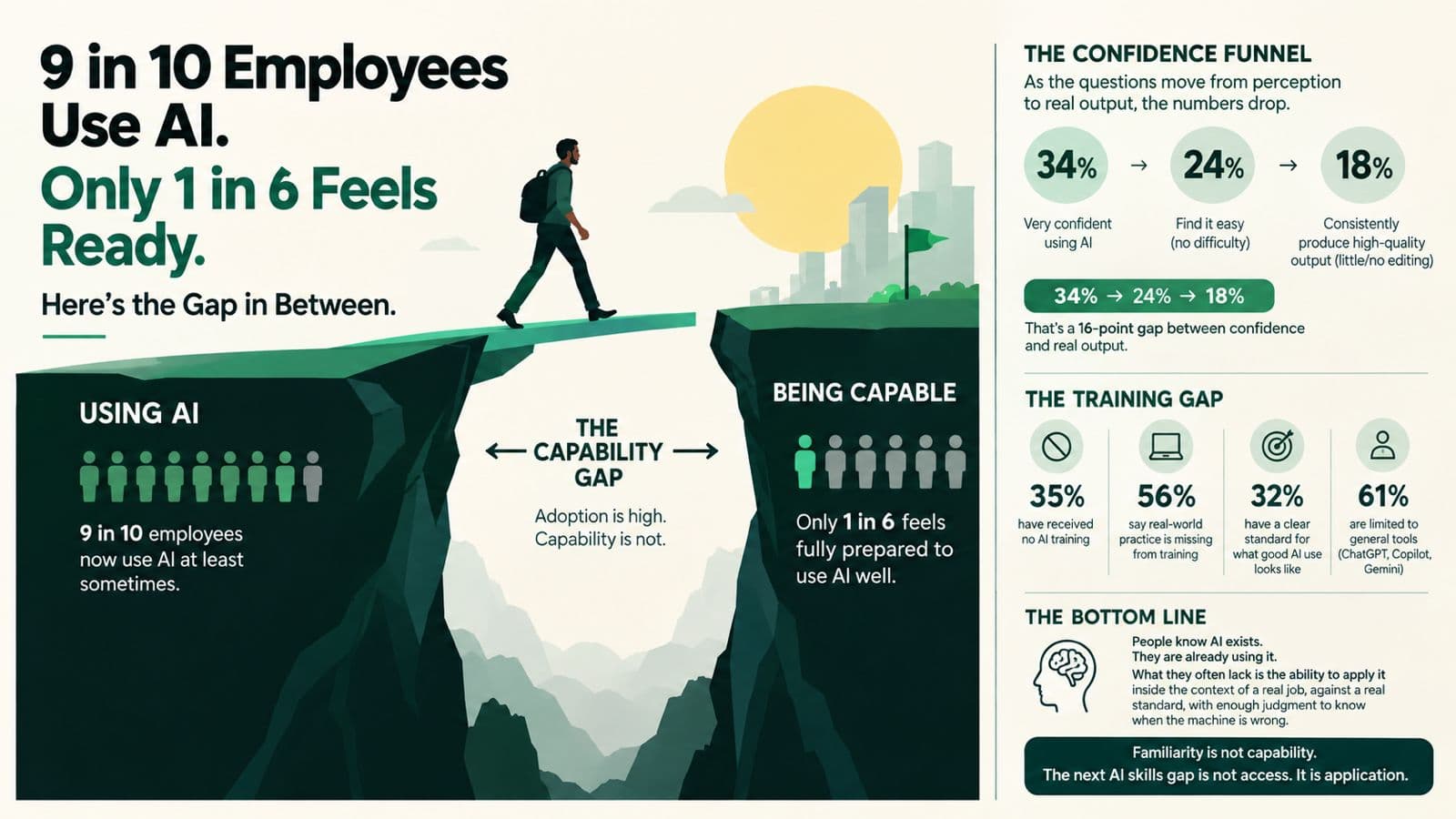
Nine in ten employees now use AI at least sometimes. Only one in six feels fully prepared to use it well. That's the headline finding from Study.com's 2026 State of AI Jobs and Skills Report, drawing on two combined 2026 employee surveys totaling roughly 2,000 respondents, and it sits inside an even sharper pattern buried in the same data.
The confidence funnel
Ask employees to rate themselves and the numbers look reasonable: 34% feel confident using AI for everyday tasks. Ask a slightly harder question and the number drops: only 24% say they find it easy. Ask what actually shows up in their work, output that's high-quality with little or no editing required, and the number drops again, to 18%. Confidence, ease, and quality form a descending staircase. Each step closer to what actually matters, fewer people are still standing on it.
That 16-point gap between how confident employees feel and what they actually produce is the report's most useful finding. It means the companies relying on self-assessment to figure out who needs training are working from an unreliable map.
The training that exists mostly isn't working
35% of employees have received no AI training at all. Of the 65% who did, only 18% say it prepared them to work independently. The single most common complaint, cited by 56% of trained employees, is that training lacked practice on real work tasks, generic AI literacy content instead of anything tied to what the person actually does.
This isn't a motivation problem. 54% of employees want to improve their AI performance, and 67% say they'd need only two hours a week or less to meaningfully close the gap. The barrier isn't willingness. It's that most training wasn't built around the job.
Employees are teaching themselves faster than employers are teaching them
A separate report, iCIMS's September 2026 Workforce survey of 1,000 US job seekers, found the same pattern from the employer side. 47% said they'd actively worked on their AI skills in the past six months, up from 41% a year earlier. The share teaching themselves AI skills specifically rose from 22% to 30% in that same year. Employer-provided training barely moved, holding at roughly one in six workers.
The catch: iCIMS's broader survey found 61% of job seekers overall, not just the self-taught, describe their AI proficiency as still limited to general-purpose tools like ChatGPT or Copilot. Specialized, job-relevant skills, prompt engineering, model evaluation, remain rare. Self-teaching closes the familiarity gap. It doesn't close the capability gap, because nobody self-teaches the specific judgment their particular job requires.
Two independent surveys, measuring different populations with different methods, land on the same conclusion. Confidence and adoption have moved fast. Real, job-specific capability hasn't kept pace, and almost nobody, not the self-taught employee, not the undertrained new hire, is closing that second gap on their own.
What actually closes it
Study.com's data points to a specific design, not just more training hours. The gaps employees report most consistently are practice on real work tasks, clear standards for what good output looks like, and guidance on catching AI's mistakes, not abstract AI literacy. iCIMS's data adds the market stakes: 42% of job seekers say a company offering real AI training is more attractive, and some would take lower pay for it.
This is the design Mozisha builds around. Our operators aren't handed a general AI literacy course and left to self-teach the rest. They're trained on the specific judgment a role requires, alongside the AI fluency to work with it, so the gap between confident and capable never opens up in the first place. That's the difference between an operator you have to hope closes the gap themselves, and one who arrives having already closed it.
Sources: Study.com, "State of AI Jobs and Skills Report 2026," conducted with Candova (survey of 1,000 employees, Pollfish, March 2026); iCIMS, "ICIMS Insights: September 2026 Workforce Report" (September 2026).