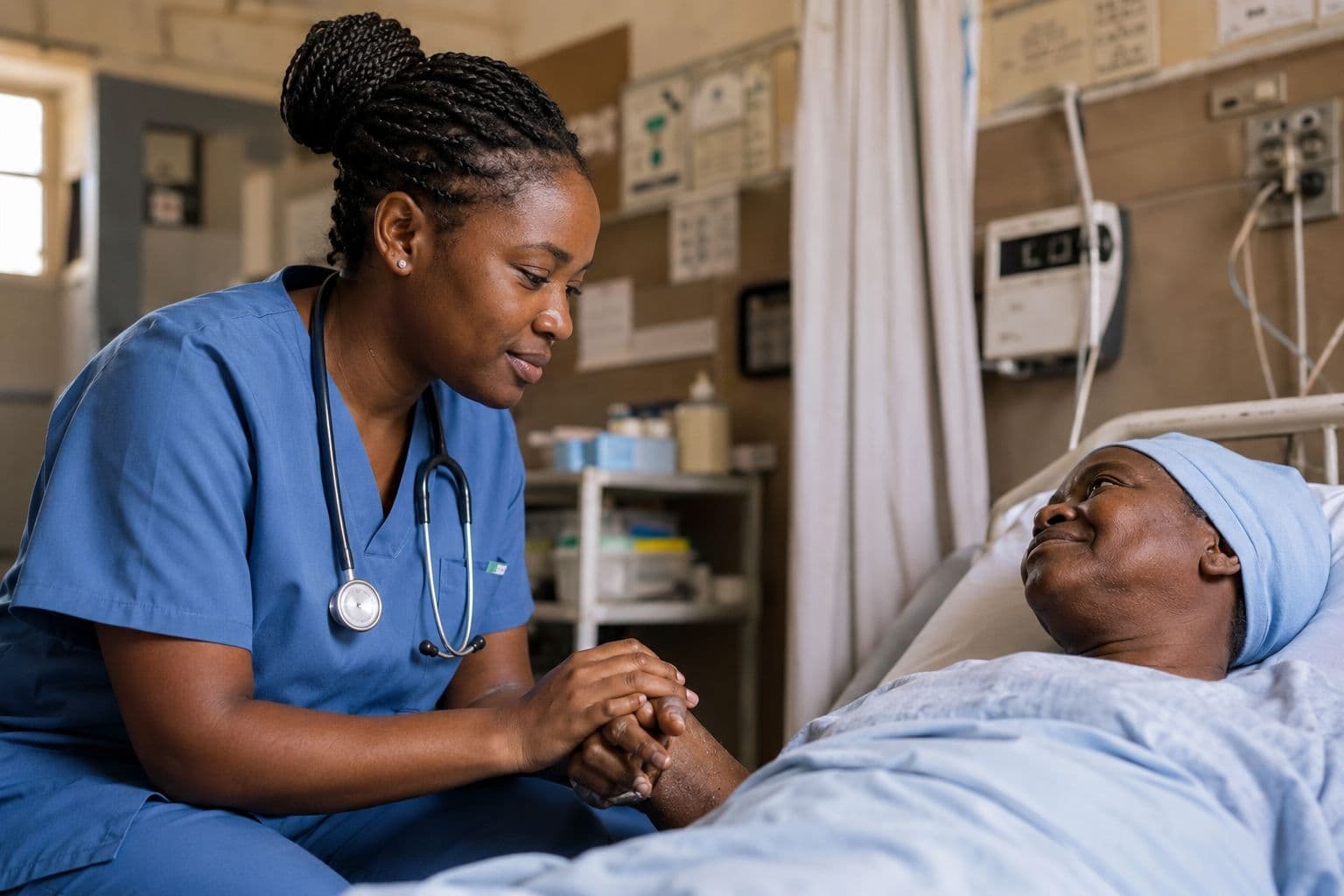
Who Will Hold The Patient's Hand
Last month, Mozisha hosted the second episode of our AI Series, a conversation focused on healthcare. We brought together Dr. Chidi Akusobi, a physician-scientist from Stanford University working on clinical AI, Dr. Maureen Etuket, co-founder of Pumzi Devices in Uganda, and Faith Emoruwa, a perioperative nurse in Lagos specialising in Da Vinci robotic surgery. The conversation was structured. It became honest. And one thread kept pulling everything back to the same place.
Not data. Not infrastructure. Not funding.
Training.
The hospital director and the quiet revolution
Dr. Maureen Etuket told us a story that stopped the conversation in its tracks. A hospital managing director in Uganda shared with her how, when he took over, women were dying at an alarming rate from postpartum hemorrhage. He did not introduce new devices. He did not deploy AI. He did not apply for a grant.
He improved training.
With better training and a culture of diligence, nurses became more confident, more capable, and more consistent. Maternal deaths fell. The intervention was not technological. It was human.
Maureen drew the lesson plainly: when you train people the right way, they are able to solve the right problems the right way. Before we introduce the fancy equipment, before we talk about the software, before we build the AI models, we have to deal with the training. That is the first thing.
What happens when training stops
Faith Emoruwa works in one of the few fully functioning robotic surgery centers in all of Nigeria. She described what happens when a surgeon is at the console and an error message appears on the system.
The error message gives no context. Just a sequence of numbers. Faith and her team had no training on what those numbers mean. The patient was under anesthesia. They could not wait. So they took a picture and sent it to the technical team, who were in the United States.
While they waited, they had to undock the robot, reposition the patient, check the ports, redock, all under the pressure of a patient who could not stay under anesthesia indefinitely, all while managing the risk of sterility being compromised at every step. When the answer finally came back, it was simple. The system was overheating. Turn up the air conditioning.
Nobody designed that moment into their training. Nobody had to. The assumption was that the technical team would handle it. But the technical team is not in the theater at 3 in the morning. The clinical team is.
Faith's team eventually created their own booklet of error codes and what they mean. They built, from scratch, the institutional knowledge that should have been given to them. That is the human layer doing the work that the system failed to design for.
The funding gap and what it reveals
Maureen raised another dimension of the training problem. With international donor funding contracting across multiple African countries, training programs that were already under-resourced have collapsed further. Nurses who should be being trained are not being trained. And into this gap, AI is being introduced.
The question she asked was direct: who are we to introduce AI when the actual nurses being trained are not being trained?
It is a fair question. A powerful tool deployed into a system where the human layer is not equipped to use it does not improve the system. It adds confusion to it. The error message on the robotic surgery system was not a technology failure. It was a training failure. The technology did exactly what it was designed to do. The people around it had not been prepared for what that meant in practice.
The numbers and what they demand
Africa produces over 325,000 trained health workers each year, according to a 2026 World Health Organization report. Most of them enter a system that is still using a curriculum designed for a different era, one in which the primary skill of a healthcare worker was the ability to recall and apply information stored in their memory.
That world no longer exists. The information is available. What is scarce is the judgment to use it well, the critical thinking to interrogate what an AI tool produces, the adaptive capacity to operate in environments where the technical support is thousands of miles away, and the human skill to sit with a frightened patient and make them feel safe.
Dr. Chidi Akusobi said it plainly: we cannot outsource critical thinking to AI. We should not outsource empathy either. Both are skills that have to be developed through practice, through experience, through the hard work of learning that cannot be shortcut.
But our institutions are not teaching those things. They are still teaching recall. They are still designing assessments around information retrieval. And because AI can now do the retrieval faster and more comprehensively than any student, students are using it to do exactly that, completing their work without building the underlying cognition that the work was designed to develop.
We are producing a generation of health practitioners who are graduating with credentials and without judgment.
What AI-fluent African healthcare training actually looks like
The answer is not to ban AI from the training environment. That is neither realistic nor desirable. The answer is to redesign training around the things AI cannot do.
Training has to shift in four ways, each of them harder than the one that came before.
First, practical examination has to replace written assessment as the gold standard. You cannot use AI to demonstrate clinical judgment in a simulation. You cannot outsource the decision of how to respond when the robot gives you an error code and the patient is under anesthesia. You cannot ask AI to hold a patient's hand. Assessment has to test the things AI cannot do, not the things AI can now do better than the student.
Second, simulation has to be contextualised to African clinical realities. Not generic clinical scenarios imported from Western training programs, but scenarios designed around the conditions our health workers will actually face. The generator that cuts out mid-procedure. The equipment that is shared between three hospitals. The patient whose normal blood pressure reads as hypertensive on a Western chart. The dialysis center managing patients at PCV levels that an American electronic medical record would flag as a crisis. African health workers need to be trained on African conditions, by African instructors who understand the operating environment from the inside.
Third, technology literacy has to sit alongside clinical skill, not behind it. Faith's team should have known what those error codes meant before they encountered them in a live surgical setting. Training should include the failure modes of the technologies health workers will use, not just their intended operation. When the technology breaks, and it will break, the human in the room needs to know what to do.
Fourth, AI has to be introduced as a thinking partner, not a replacement for thinking. The most dangerous outcome in healthcare education right now is not AI replacing doctors. It is students who have never been trained to think critically, using AI to bypass the process of learning how to think, and graduating without the cognitive foundation to recognise when AI is wrong. A model that confidently produces a wrong diagnosis to a student who cannot tell the difference is more dangerous than no model at all.
The opportunity
This is where Mozisha sits.
Our work is not simply about placing African talent into global roles. It is about building the layer of human capability that makes AI valuable rather than dangerous. The human layer that translates AI potential into real outcomes on the ground.
We train operators across four tracks (Growth, Revenue, Product/Design, and Operations), and across more than fifteen industries, including healthcare. What unites the training across all of them is the same conviction Maureen named for healthcare. Technical fluency is becoming table stakes, and our operators are AI-fluent by design. What we work hardest to develop is the layer underneath. How to think critically when a tool gives you a confident wrong answer. How to act with judgment when the technical support is thousands of miles away. How to read a situation, hold a difficult conversation, and deliver care or service with the kind of human presence that no machine can replicate.
One of our healthcare-adjacent operators recently caught a quiet pattern in a US clinic's patient communications data that the existing tools had missed. The AI was producing reports. She was reading the reports against what she knew about how patients actually behave when they are about to disengage from care. She flagged the pattern, the clinic intervened, retention improved. That is what the human layer looks like in practice. The AI did the volume. The human did the work the volume was supposed to be in service of.
Healthcare is where the stakes are most visible, but the same logic applies to every domain where AI now sits on top of human work. The systems break when the training has not kept up. Mozisha is built to close that gap, across industries and across roles.
Africa has something older systems do not: the freedom to build differently. Western hospitals are inheriting legacy infrastructure, legacy processes, and legacy training models. African institutions are not. That is not a disadvantage. It is a mandate and an opportunity.
The continent that gets training right in this decade, that produces workers who can think critically, adapt rapidly, work alongside AI tools with genuine competence, and deliver work with the irreplaceable human qualities that no tool can replicate, that continent will not just have a better economy. It will have a model the rest of the world needs.
We are building toward that. One trained operator at a time.