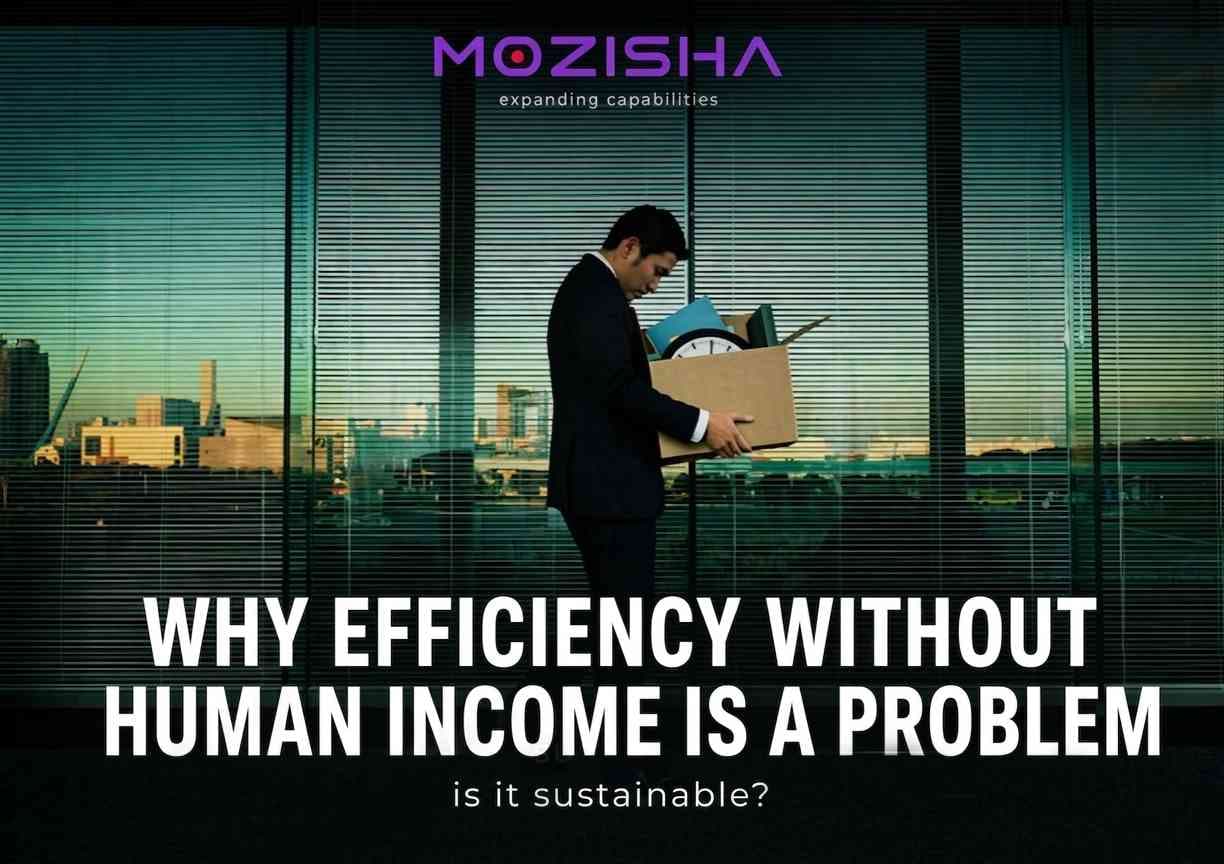
At first, it sounds like progress. Costs fall, production speeds up, profits rise, but then what happens to the people whose incomes disappear?
And if those people lose their income, what happens next?
Who is buying the products?
Think about it carefully. If billions of people no longer have stable earnings, how do they keep spending? And if they stop spending, what happens to the companies that depend on that spending to survive?
Is production still valuable when there is no demand to meet it?
Economies run on a loop. People work, earn money, and then spend that money on goods and services. That movement of money is what keeps businesses alive. This idea is captured in the circular flow of income. So what happens when one side of that loop breaks?
If AI takes over the role of labor, where do wages come from? And if wages disappear, what replaces the purchasing power that businesses rely on?
Take major companies like Amazon, Apple, or Tesla. Their success depends on scale. Millions of everyday people buying their products. But what happens when those same people no longer have the income to participate in that market?
Do these companies end up selling only to a small wealthy group? And if so, can that smaller market sustain the same level of growth, production, and profit?
Or does the entire system begin to shrink?
So what do companies gain by cutting labor costs with AI if, in the process, they weaken their own customer base?
Does it become a cycle like this?
More AI leads to fewer jobs.
Fewer jobs lead to less income.
Less income leads to weaker demand.
Weaker demand leads to falling profits.
If that happens, was the efficiency gain really a gain at all?
So the real question is not whether AI can replace human work. It clearly can replace a lot of it.
The real question is this: what replaces the role humans play in the economy?
If humans are removed as workers, can they still function as consumers?
And if they cannot, who exactly is the economy producing for?