In the first week of May alone, Meta announced 8,000 job cuts. Microsoft offered buyouts to nearly 9,000 workers for the first time in its 51-year history. PayPal said it would eliminate 20% of its entire workforce. Coinbase cut 14% of staff. Every announcement cited the same driver: artificial intelligence.
They are not alone. Over 150,000 tech jobs have been eliminated in 2026 so far, the largest wave of tech workforce displacement in a decade. And the spending tells you where the money is going instead. Meta, Microsoft, Amazon, and Alphabet are pouring a combined $725 billion into AI infrastructure this year. A 77% increase over last year. The destination is compute, not payroll. Data centres, not people.
Now here is the question nobody in Silicon Valley is asking: what happens to the young people on the other side of this wave? The ones who have not even entered the job market yet?
In South Africa, where nearly 60% of young people between 15 and 24 are unemployed, we cannot afford to wait for the answer. We have to build it.
Two Stories About AI. Only One of Them Gets Told.
The story the world keeps hearing is about destruction. AI replacing workers. AI eliminating departments. AI turning billion-dollar companies into leaner, smaller machines.
But across Africa, a completely different story is unfolding. Young people are not being replaced by AI. They are wielding it to solve problems that have persisted for decades.
In Zambia, Tafadzwa Kalisto Munzwa built Dawa Health, a multimodal AI system that detects pre-cancerous lesions with 96.7% accuracy and cuts anaemia detection from three days to five minutes for rural midwives. In communities where the nearest specialist is hours away, that is not a tech novelty. It is a lifeline.
In Zimbabwe, Tafadzwa Chikwereti built CropFix, a mobile platform where smallholder farmers photograph their crops and receive AI-powered diagnoses of pests, diseases, and nutrient deficiencies delivered via SMS, WhatsApp, or USSD. No smartphone required. No internet required. Just a basic phone and a photo.
In Senegal, Kera Health built an AI platform connecting patients, doctors, clinics, laboratories, pharmacies, and insurers into a single integrated system. Backed by $10 million from the International Finance Corporation, they are now expanding beyond Dakar across West Africa.
In Cape Town, Zindi built a community of over 80,000 data scientists across 52 African nations and developed a computer vision solution for UNICEF and the government of Malawi to map flood-affected communities in real time. In Nigeria, Data Science Nigeria built SpotOn, a geospatial AI platform that maps rural health facilities, backed by $1.3 million from the Bill and Melinda Gates Foundation.
None of these founders are trying to make a company "leaner." They are trying to make a continent healthier, better fed, and more connected. In Silicon Valley, AI is a cost-cutting tool. In Africa, it is an infrastructure-building tool. The same technology, pointed in completely different directions.
The African Union's Commissioner put it plainly: "The next generation of AI architects must be African, educated in Africa, and working to solve African problems."
That is exactly what we are building toward.
What We Are Doing About It
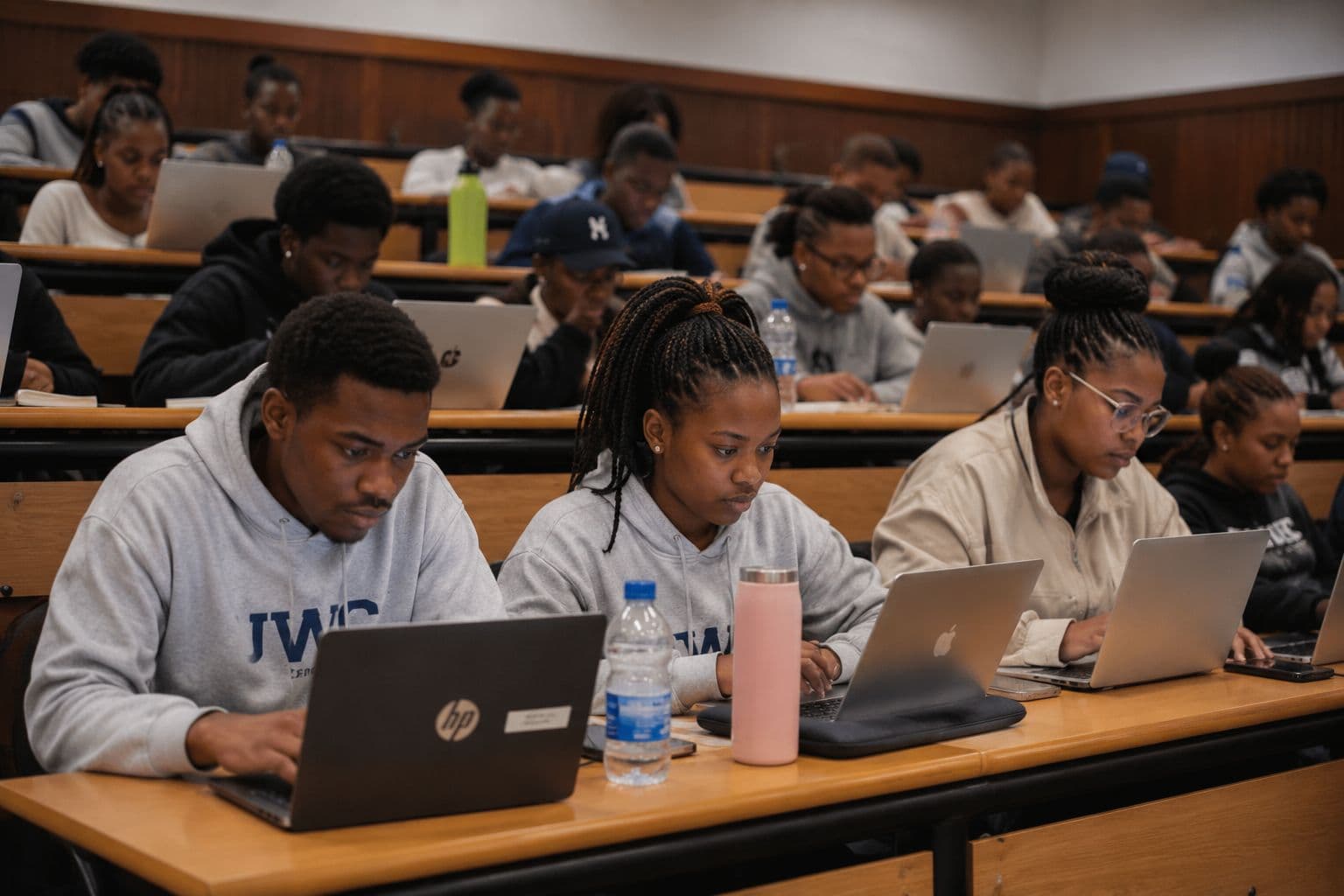
For the past semester, we have been running the Mozisha AI Employability Lab at the University of the Western Cape. It is an in-person, hands-on programme that teaches students to use AI as a strategic co-worker rather than something to fear or blindly hand their thinking over to.
No slides. No theory. Every session, students open their laptops and build. A cover letter that demonstrates strategic research. An AI integration strategy brief for their specific industry. A prototype solution for a real-world problem. A professional blog to market their new skills. By the time they leave, they have a tangible Proof of Work asset they can show an employer or use to launch a venture.
We call the core skill Creative Synthesis: the ability to combine your domain expertise, cultural intelligence, and lived experience with AI to produce something neither you nor the machine could have created alone.
Or as we tell every cohort: Humans pick the two islands. AI builds the bridge.
What Happened When the Students Got It
You can teach a framework all day. What matters is the moment it clicks.
This semester, we watched that moment happen over and over. And then something we did not plan for started happening. The students began telling the story themselves, unprompted, on LinkedIn.
Adig Kabangie, a final-year Medical Bioscience student, wrote:
"Today at the Mozisha AI Lab at the University of the Western Cape, we didn't just talk about the future of work, we built for it. My biggest takeaway? AI will handle the SAS/R code generation, but it lacks the medical context to interpret clinical circumstances and ensure patient safety."
He attached an AI Integration Strategy Brief for Clinical Programming that he built during the session. Not after. During.
Shaun Chauke, an accounting student preparing for his CA(SA), posted:
"The CV is no longer the differentiator. In an era where AI generates polished resumes at scale, what separates professionals is Proof of Work: tangible evidence of thinking, building, and deciding."
He described how AI will own the quantitative execution layer but cannot exercise professional judgement, build institutional trust, or translate financial complexity into human decisions. He called that gap "the strategic opening for every accountant willing to position themselves above the automation floor." Then he attached his own AI Integration Strategy Brief for Chartered Accounting.
Thato Mphomane, a first-year Mathematical and Statistical Sciences student, opened with:
"Most data scientists will be replaced by AI. The ones who won't? They stopped competing with it."
She published her personal AI Integration Strategy Brief outlining how she plans to lead with human strategy while leveraging AI as a force multiplier.
These are not testimonials we asked for. These are students who walked out of a session and immediately started building their professional identities in public. Not "I learned something." But "I built something, and here it is."
The Data
Across multiple in-person sessions this semester, the results have been consistent:
100% of participants said they would recommend the Mozisha AI Lab to a friend. Not 95%. Every single one.
73% walked out confident they can use AI independently and strategically.
The average career-value rating was 8.5 out of 10.
The qualitative feedback tells the deeper story:
"I can still be of value in a new job field packed with AI."
"AI is not always correct, and I should not be intimidated. It is just a useful tool that I am supposed to use in my career as a future educator."
"We cannot compete with AI as the curriculum we are using was built years ago, but we can work with AI towards the same direction."
That last line deserves to sit with you. A student, in a country with nearly 60% youth unemployment, in a university system not designed for this era, figured out in one hour what most corporate executives still struggle to articulate. You do not compete with AI. You work alongside it. And you bring the things it cannot.
The Gap Is the Opportunity
The global conversation keeps framing AI as a binary: either it takes your job or it does not. The real story is about the gap between what AI can execute and what it cannot.
AI can process data, generate code, draft documents, and pattern-match at superhuman speed. It cannot exercise professional judgement. It cannot build trust. It cannot read a room. It cannot understand that a spaza shop owner in Khayelitsha has different compliance needs than a corporation in Sandton. This is exactly what our students practise in every session: applying local, human context that no AI model trained on American data could ever produce on its own.
That gap is not a weakness. It is the entire job description of the future.
The World Economic Forum estimates that 170 million new roles will require exactly this: the ability to orchestrate AI, not compete with it. The young Africans building AI-powered diagnostics in Zambia, crop intelligence in Zimbabwe, and legal prototypes for township entrepreneurs in Khayelitsha are already doing this work. They are not waiting for permission.
At Mozisha, we call that being an AI co-worker who adds value from day one. We are training young Africans to show up exactly that way. With practical AI fluency, judgement, creative agency, cultural intelligence, and a problem-solving mindset.
What Comes Next
The Mozisha AI Employability Lab is expanding. This semester at UWC was a proof of concept. A demonstration that you can take a room full of students from five different faculties, give them one hour, and have them walk out with a portfolio asset and a fundamentally different relationship with AI.
President Ramaphosa's 2026 State of the Nation Address called for a "Skills Revolution" combining academic learning with practical workplace training. We are not waiting for that revolution to be designed by committee. We are running it, one lecture hall at a time.
If you are a university, a career services department, a corporate partner, or a funder reading this and thinking "we need this for our students, our graduates, our team," I want to hear from you. Send me a message directly on LinkedIn or visit mozisha.com to bring the AI Employability Lab to your campus or organisation.
Over 10 million young Africans enter the labour market every year. The formal economy creates only 3 million jobs to absorb them. While $725 billion flows into AI infrastructure this year, we are making sure the next generation of African talent is not left behind by the wave but riding it.
The future of work in Africa belongs to the creators, not the consumers. And we have a lot of creators to raise.
Let's keep building.