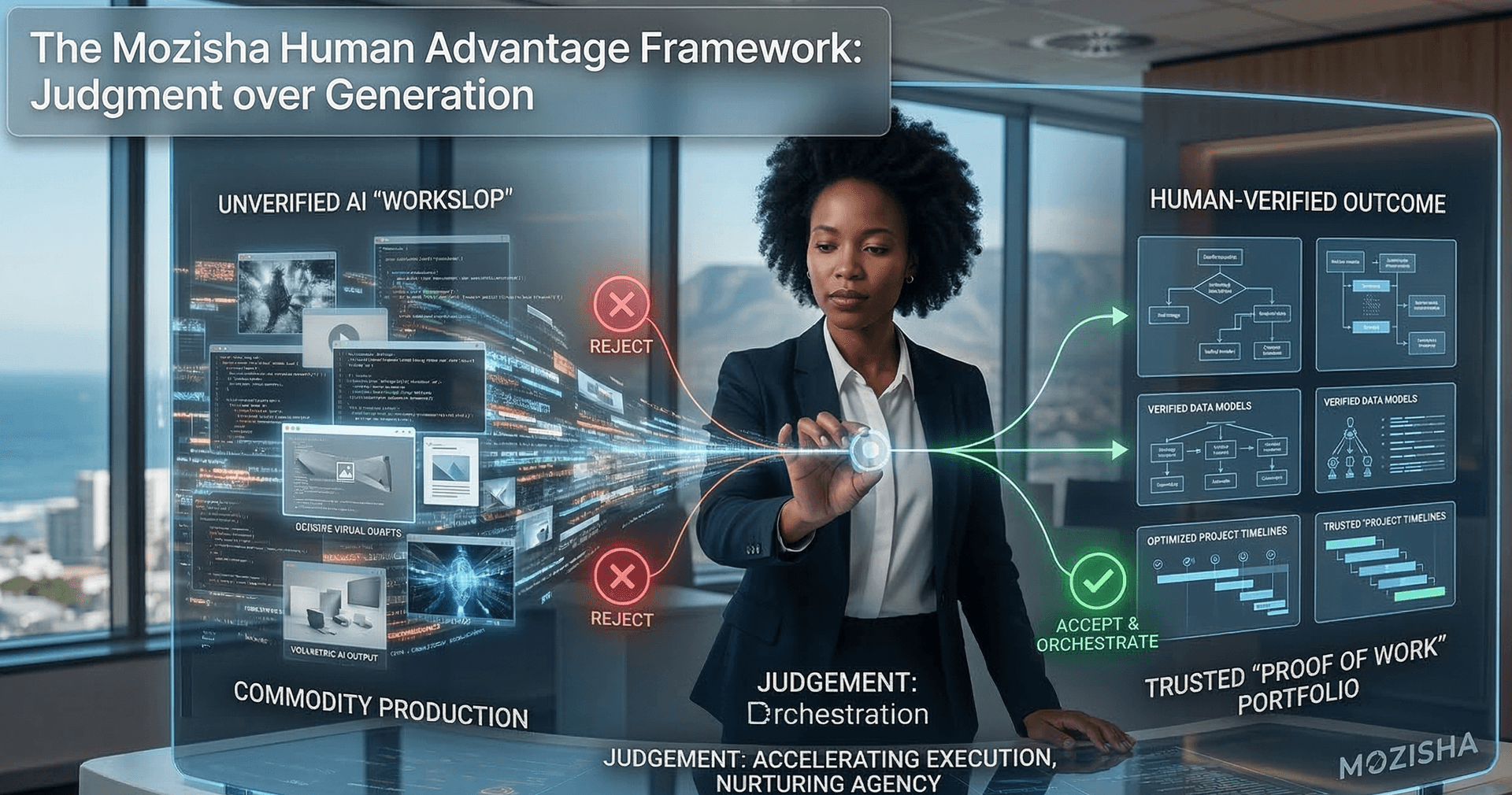
Last week we ran our first Human-Led AI Lab at the University of the Western Cape.
One of the students used an AI tool to generate a 60 second answer to a common interview question.
“Why should we hire you when you have no full time work experience?”
Within seconds, the system produced a clean, confident response.The language sounded polished. The structure was perfect. The tone felt persuasive.
At first glance, it looked like an excellent answer.
But when we slowed down and interrogated it, something became clear. Parts of the response sounded generic and oddly foreign to the local context. It referenced experiences and professional language that did not quite match the student’s reality or the South African job market.
The student’s real skill was not generating the answer.
It was rejecting parts of it.
They removed phrases that sounded too scripted.They changed the tone to reflect their own voice.They added examples from their academic projects and personal experience.
In other words, they turned AI output into something that actually represented them.
This is the shift many people still misunderstand about the AI era.
Everyone is currently obsessed with generation.
How to write the perfect prompt.How to produce faster.How to automate more work.
But the reality we are seeing on the ground is this.
Production has already been solved.
AI output is rapidly becoming a commodity.
When anyone can generate a polished answer, report, slide deck, marketing plan, or block of code in seconds, the scarce skill is no longer production.
The scarce skill is judgment.
Your most valuable AI capability is the ability to look at a confident, perfectly formatted AI output and say:
“This logic is flawed.”“This lacks real insight.”“This does not fit our context.”
In other words:
The ability to say no.
At Mozisha, we realized early that unstructured AI use can actually accelerate cognitive deskilling.
Learners slowly move from reasoning to prompting.Dependency begins to replace professional judgment.
Automation increases speed.
But speed alone does not produce trustworthy work.
That is why we built what we call the Mozisha Judgment Loop.
In our Human Led AI Learning and Employability Labs, we do not measure how clever a student’s prompt is.
We measure how clearly they think before and after using AI.
Our process is simple but strict.
- Intent
Before touching an AI tool, participants must define the problem, the success criteria, and the risks.
- Structured Critique
AI output is interrogated for logic, bias, and contextual fit.Accepting AI output without critique is considered a failure.
- Decision and Reasoning Logs
Participants document what they rejected, what they modified, and why.
This creates an auditable record of their judgment.
Because in the AI economy, the final output matters less than how the human directed the system.
And this raises a bigger issue.
Across companies today, some of the most valuable knowledge is being lost.
Every time a skilled professional rejects an AI output, they are defining a constraint.They are encoding institutional judgment.They are protecting brand integrity.
But those decisions currently disappear inside Slack threads, emails, and meetings.
We believe they should be captured.
That is why Mozisha is building infrastructure around judgment as proof of work.
For universities, this means moving students beyond static CVs toward auditable portfolios that show how they directed AI systems and exercised professional reasoning.
For enterprises, it means deploying Managed Execution Units where trained AI orchestrators run workflows with structured human oversight. Rejected AI outputs are turned into encoded business logic that strengthens institutional trust.
The old world rewarded the manual executor.
The AI world will reward the system orchestrator.
Stop competing with AI on volume.
Start directing it with judgment.