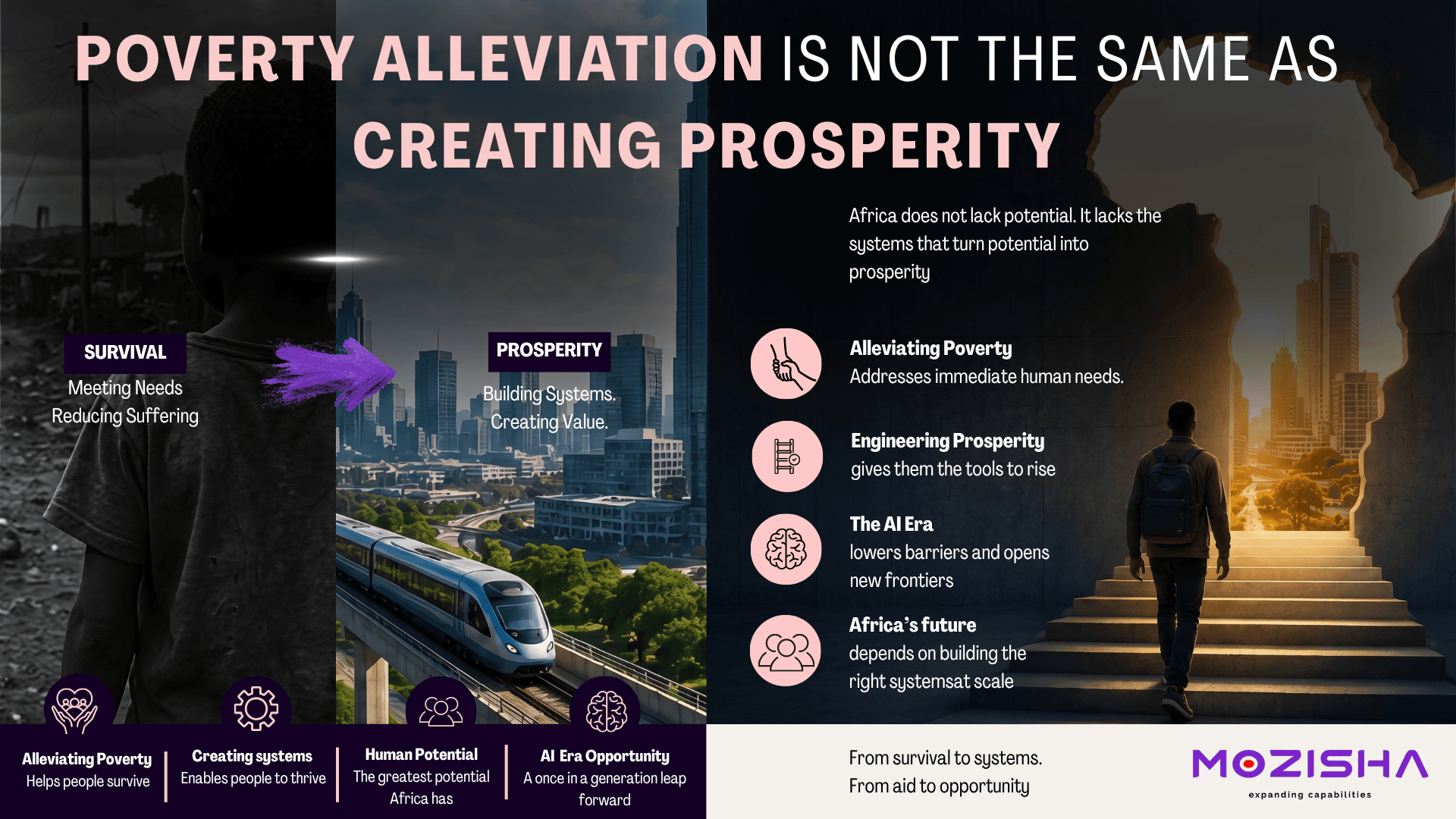
For decades, much of Africa's development conversation has centered on the urgent question: how do we reduce suffering?
How do we feed the hungry? How do we get medicine to those who need it? How do we keep children in school? How do we help people survive?
These are not small questions. They are moral imperatives. No society can call itself civilised while millions of its people lack food, healthcare, shelter, or security. Alleviating suffering is, and must remain, a foundational obligation.
But survival is not the same as prosperity.
And poverty alleviation, however necessary, is not the same as creating prosperity.
While poverty alleviation aims to improve lives, prosperity creation transforms societies. One addresses symptoms; the other rewrites the underlying conditions.
The Survival Trap
There is a story many of us know. A child grows up in a village with no electricity, no clean water, no doctor within a day's walk. Aid arrives. A borehole is sunk. A clinic is built. The child survives childhood, goes to school, crosses the poverty line that the international organisations draw with such precision. The story is recorded as a success.
And it is a success. We should not be dismissive of it.
But then that child grows up. And there is no job. No enterprise to join. No industry hungry for what she knows. The economy around her has not changed in any structural way. The borehole is still there. So is the poverty, wearing a slightly different face.
Most poverty interventions are designed around immediate needs. They provide food, cash transfers, scholarships, healthcare, and humanitarian support. They reduce suffering, extend lives, and meaningfully improve well-being. Many are indispensable.
But they rarely disturb the underlying economic system that produces poverty in the first place.
A person may move from extreme poverty to stability. Their children may attend school. Their household may cross an income threshold. And yet the broader economy may remain structurally unchanged — few productive enterprises, limited innovation, weak institutions, insufficient infrastructure, not nearly enough opportunity for large-scale wealth creation.
Poverty can be reduced without prosperity being built.
Prosperity is not the absence of poverty. It is the presence of productive capacity, a dynamic, self-reinforcing system in which people create value for one another at scale, and in which that value circulates, compounds, and generates new opportunity over time.
When that system is absent, reducing poverty becomes a perpetual project rather than a transitional phase. Resources flow in, conditions improve modestly, and the structural conditions that reproduce poverty remain intact.
Prosperity Is Engineered
There is a tendency, in certain circles, to speak of prosperity as though it were weather. As though it descends on some nations and not others by some combination of luck and geography and perhaps some quality in the people themselves that cannot quite be named without embarrassment.
Prosperity is engineered. History is unambiguous about this.
Prosperous societies share a common architecture. They develop institutions that protect property, enforce contracts, and reduce the costs of economic coordination. They build infrastructure that connects people to markets and to ideas. They create talent pipelines that continuously convert human potential into productive capacity. They establish capital markets that allow promising ventures to grow. They cultivate ecosystems that reward problem-solving and create new industries.
None of this happens by accident. It is designed, contested, built, and rebuilt across generations.
The Industrial Revolution did not merely alleviate poverty. It created entirely new systems of production, distribution, and exchange that elevated living standards across generations and geographies. It was not a charity project. It was a systemic transformation of how human beings organised their labour and created value.
The digital revolution followed the same pattern. It did not merely help people survive. It created new industries, new professions, new markets, and new forms of global participation that were unimaginable a generation before.
In both cases, prosperity was the outcome of deliberate system design. Of institutions, incentives, infrastructure, and human capability working in coordination.
Prosperity engineering is not the responsibility of governments alone. It requires an ecosystem: governments that create enabling conditions, private enterprises that generate productive work, educational institutions that develop talent, investors willing to finance innovation, and civil society and development organisations that can convene actors, de-risk experimentation, and catalyse systemic change. Prosperity emerges when these actors operate as a system rather than in isolation. When one part of the system fails, prosperity becomes difficult to sustain. When the system works, societies compound wealth across generations.
Africa's Development Paradox
Africa has made significant progress over the past three decades. Poverty rates have fallen across much of the continent. Life expectancy has risen. Child mortality has declined. Access to primary education has expanded substantially. Some of this progress was delivered by aid. Vaccines saved lives. Boreholes provided clean water. Emergency relief prevented famines. These interventions were not wrong. The argument here is not against them. The argument is that they were never designed to build prosperity, and we made the mistake of acting as though they were.
The data, when you look at it honestly, is sobering. All figures are drawn from World Bank World Development Indicators, measured in constant 2010 US dollars via the Federal Reserve Bank of St. Louis, so the comparisons are real and inflation-adjusted.
In 1960, at the very moment many African nations were writing their first constitutions and raising their flags for the first time, Liberia had a real GDP per capita of around $2,444. By 2024 it stood at roughly $665, a decline of about 73 percent across two generations. The Democratic Republic of Congo fell from around $1,303 to $554 over the same period, a loss of roughly 57 percent.
These are not the figures of neglected countries. They are the figures of heavily intervened-in countries, recipients of decades of aid, structural adjustment programmes, and elaborate development architecture. Yet the long-run record is clear: average living standards in both countries remain below where they stood at independence. The underlying wealth-generating capacity of these economies did not grow. In many cases it shrank.
But it is Nigeria that tells the most instructive story of all.
On paper, Nigeria looks like a relative success. Its inflation-adjusted per capita income is higher today than at independence. The economy has grown. The numbers appear to move in the right direction.
And yet the World Bank estimates that 63 percent of Nigerians, roughly 140 million people, now live below the poverty line. Between 2018 and 2025 alone, an additional 42 million Nigerians fell into poverty. Africa's most populous nation, sitting on some of the continent's most abundant natural resources, grew its economy for decades while the majority of its people got poorer.
How is this possible?
Because GDP growth and prosperity creation are not the same thing. Nigeria's growth has been driven almost entirely by oil, a sector that employs a tiny fraction of the population and concentrates its returns in very few hands. The broader economy, the one that most Nigerians actually live inside, has not been built. There are not enough productive enterprises. Not enough industries that employ people at scale. Not enough systems that convert ordinary human effort into sustainable livelihoods.
Nigeria did not fail to grow. It failed to build the systems through which growth becomes prosperity.
That is the distinction the dominant development paradigm has consistently missed. It counts money in. It counts GDP up. It rarely asks whether the underlying economy is becoming more productive, more inclusive, or more capable of generating and sustaining wealth for the people who live inside it.
This is not a condemnation of aid or social protection. Every society, including the wealthiest, maintains safety nets. Poverty relief, emergency response, and social investment all have legitimate and necessary roles.
Safety nets can protect societies in moments of crisis. But no society has ever become prosperous by relying indefinitely on external transfers.
Prosperity requires ladders. Systems that enable people not merely to be protected from economic failure, but to actively participate in economic creation.
The AI Transition: Risk and Opportunity
Artificial intelligence is not simply a productivity tool or a new industry. It is a structural shift in how economic value is created, where it concentrates, and who gets to participate in its generation. It is rewiring global labour markets, collapsing entry barriers in some domains while erecting entirely new ones in others, and creating new categories of work that did not exist five years ago.
For Africa, this transition carries both profound risk and historic opportunity. The risk is familiar. That a technological revolution driven elsewhere will concentrate wealth in places already wealthy, while displacing workers in industries where many Africans currently earn livelihoods. That Africa becomes, once again, a consumer of technologies it did not build and does not control. That the continent's young people are trained for a world that has already moved on by the time they finish training.
But the opportunity is equally real, and far less appreciated in the conversations that matter.
The structural advantage Africa holds in the AI era is people. A median age of nineteen. A workforce growing faster than anywhere else on earth. Hundreds of millions of young people who are digitally fluent, adaptable, and hungry for work that dignifies them. These are not development statistics. They are the raw materials of economic transformation.
AI is reshaping work faster than traditional education and labour market systems can adapt. New forms of value creation, remote technical work, AI-assisted problem solving, digital services, software development, creative production, are opening to people regardless of where they were born, which university they attended, or which passport they carry.
A talented young person in Nairobi, Lagos, Kigali, or Accra can now contribute to global value chains without relocating. Without inherited capital. Without the credentials that once kept those doors firmly closed.
But this opportunity will not become prosperity on its own.
Without intentional systems for talent identification, work-integrated learning, skills credentialing, and opportunity matching, Africa risks producing a generation of people who are trained but not deployed, educated but economically disconnected. Equipped with skills the market values, yet unable to convert those skills into sustained livelihoods.
What Must Be Built
Building prosperity in the AI era requires a new kind of human infrastructure. Not infrastructure designed for the twentieth-century economy that the continent was largely excluded from, but for the one that is rapidly emerging and in which the terms of participation have not yet been fully set.
This means rethinking how talent is identified. The most economically productive people in the AI economy are not always found through traditional academic filters. They emerge from communities, from self-teaching, from practical problem-solving, from necessity, which has always been Africa's most underacknowledged teacher. Systems that wait for formal credentials to identify talent will miss most of it, systematically, generation after generation.
It means redesigning how learning happens. The gap between formal education and economic usefulness is too wide and too slow to close with conventional curriculum reform. Learning must be embedded in real work. Structured apprenticeships. Project-based experiences. Live exposure to the demands of productive enterprise. Education that does not connect to economic activity is, increasingly, a form of elaborate and expensive delay.
It means creating new mechanisms for signalling capability. Credentials are proxies for competence, and those proxies are breaking down even in the societies that built them. New trust architectures must emerge. Verified portfolios, demonstrated project outcomes, industry-endorsed certifications, performance-based assessments that allow employers and clients to identify and engage talent they cannot see through traditional channels.
It means building the connective tissue between talent and opportunity. Having skills is necessary but not sufficient. Markets for talent, platforms, networks, intermediaries, accelerators, must actively broker connections between capable people and the enterprises that need them.
And it means cultivating institutions designed not merely to reduce unemployment, but to maximise human productivity at scale. To continuously convert raw human potential into economic participation.
What Mozisha Believes
At Mozisha, we believe Africa's future prosperity will be built through people. Not people in isolation, but people systematically identified, developed, validated, and connected to opportunity.
The continent needs a new human infrastructure for the AI economy. One that does not wait passively for opportunity to arrive, but actively engineers the conditions under which millions of Africans can participate meaningfully in the global economy being built around them.
This means building learning systems tightly connected to real work. It means forging industry partnerships that ensure training reflects genuine market demand. It means creating new forms of apprenticeship and experiential learning at scale. It means developing trusted mechanisms for signalling skills and capability. It means constructing ecosystems that enable young people to move rapidly from learning to earning, and from earning to building.
Our mission is not to help young Africans survive the AI transition.
It is to help build the systems that enable millions of them to shape it.
Because prosperity is not donated. It is not transferred. It is not the residue left behind after poverty is cleared away.
Prosperity is built. Through deliberate system design, sustained investment in human capacity, and an honest reckoning with what economies actually require to generate and sustain wealth.
Africa's next chapter will depend on our collective willingness to engineer it. The question is not whether it can be done. The question is whether we will have the courage and the patience to do it ourselves.