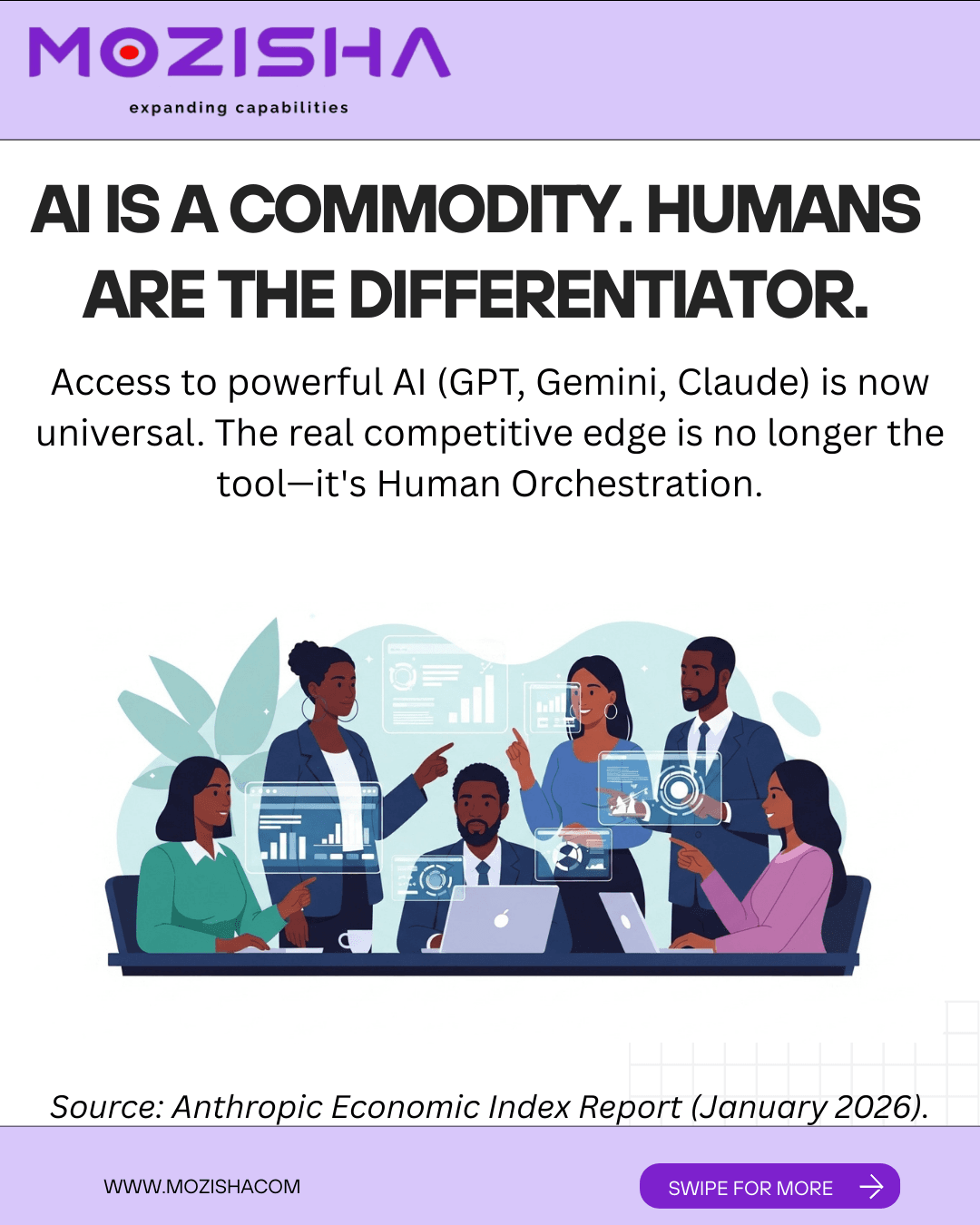
For most of modern history, advantage came from owning the tool.
The factory.The machine.The computer.
Artificial intelligence changes this logic.
Today, the most powerful AI systems are widely available. The same large language models—Claude, Gemini, GPT—are accessible to startups and governments, multinationals and students alike. The marginal cost of intelligence is falling rapidly.
Access is no longer the constraint.
Capability is.
This reality is captured with unusual clarity in Anthropic’s Economic Index Report (January 2026), which studies how AI is actually used across countries, industries, and skill levels. One of its most striking findings is this:
The sophistication of AI outputs is almost perfectly correlated with the sophistication of the human inputs.
In plain terms: AI does not create advantage on its own. It amplifies human skill.
The Illusion of AI Adoption
Much of the global conversation about AI—especially in emerging economies—centers on adoption:
- Who has access?
- Who is deploying models?
- Who is “AI-ready”?
But Anthropic’s research shows that adoption alone explains very little.
Countries and regions with similar levels of AI usage experience dramatically different outcomes. The difference is not the model. It is the human capital layer—education, judgment, and the ability to work with AI rather than defer to it.
The report demonstrates a near-perfect correlation between:
- The education level required to understand human prompts
- And the education level reflected in AI responses
How people prompt is how the AI responds.How people think is how the AI performs.
This has far-reaching implications:
- AI will widen gaps where human capability is uneven
- Infrastructure without skills will produce limited returns
- The real contest is no longer technological—it is human
AI Is the Tool. The Human Layer Is the System.
Consider two companies using the same version of Google Gemini.
One extracts marginal value.The other builds durable advantage.
The difference lies in what we call the Human Layer:
- People who know how to frame problems clearly
- Professionals who can evaluate AI output critically
- Teams that can translate probabilistic suggestions into real decisions
AI can generate options.Humans must choose.
AI can accelerate workflows.Humans must align them with strategy, ethics, and context.
This is human orchestration—the ability to direct, supervise, and integrate AI into real-world systems.
In an era where models are increasingly similar, orchestration becomes the differentiator.
Africa’s Strategic Opportunity: The Demographic Dividend
Africa enters the AI age with a distinctive asset: its people.
More than 60% of Africans are under the age of 25. This youthful population is often framed as a challenge—jobs, infrastructure, education systems under strain.
But in the AI era, youth is not a liability.It is a strategic advantage.
AI does not primarily demand factories or heavy capital. It demands:
- Cognitive skill
- Language fluency
- Analytical reasoning
- Applied judgment
These are learnable capabilities.
With the right investment, Africa can become the human capability layer of the global AI economy—not as passive users of tools, but as:
- Interpreters of AI systems
- Evaluators of automated outputs
- Translators between models and business value
This is not about cheap labor.It is about high-leverage human partnership.
Why Skills Matter More Than Models
Anthropic’s Economic Index Report reinforces a critical truth:AI performs best when humans remain in the loop.
Higher-income, higher-skill regions use AI more collaboratively—augmenting human judgment rather than delegating decisions entirely. These users extract more value not because AI is smarter, but because they are .
Three forms of expertise matter most:
- Linguistic expertise – expressing intent, nuance, and constraints clearly
- Evaluative expertise – validating logic, spotting errors, assessing reliability
- Applied expertise – turning insight into execution within real systems
Without these, AI output is brittle.With them, AI becomes a force multiplier.
Mozisha and the Architecture of the Human–Tool Relationship
This is where Mozisha—and the broader Anthrovian vision—comes in.
We believe Africa’s role in the AI economy is not to compete on models or compute, but to lead on human capability.
Mozisha exists to develop professionals who can:
- Work alongside AI systems effectively
- Bridge the gap between AI output and business outcomes
- Provide the judgment, context, and oversight AI lacks
We invest in people because infrastructure without skill is idle capacity.
Our work is not merely training.It is the deliberate construction of the human–tool relationship.
In a world where AI is increasingly a commodity, the rare asset is skilled human orchestration.
That is the future we are building toward.
Conclusion: The Differentiator Remains Human
AI will continue to improve.Models will grow faster, cheaper, and more capable.
But advantage will not flow automatically.
Those who invest in human capability will compound value.Those who rely on access alone will plateau.
Africa’s opportunity is not to arrive late to the AI race, but to arrive strategically—by building the people who make intelligent systems truly useful.
That is the work Mozisha has chosen.
Not to chase technology.But to shape how it is used.